What do the biggest multifamily property management companies use to scale? Explore the technology and strategies that support growth.
The biggest multifamily property management companies scale with systems, not just more properties
The biggest multifamily property management companies don't grow by simply adding more communities and more employees.
They grow by building operational systems that can handle more properties, more data, and more complexity without creating more manual work.
Large operators rely on standardized workflows, connected technology, accurate reporting, and processes that allow teams across different markets to work from the same information.
The lesson for growing operators is simple: the systems that support a 10,000-unit portfolio are often the same systems a 1,000-unit portfolio needs before growth makes things messy.
(Waiting until everything breaks is a surprisingly popular implementation strategy. It is also not a great one.)
Key Takeaways
- Large multifamily operators scale by creating consistent workflows across properties and teams.
- Multifamily software should support daily operations, not create more administrative work.
- Reporting, integrations, and centralized information become more important as portfolios grow.
- The right technology helps teams reduce manual processes and make better decisions.
- Growth works best when operations are built before complexity takes over.
What separates large multifamily operators from smaller teams?
The biggest difference is usually not portfolio size. It is operational maturity.
A smaller property team can often rely on conversations, individual knowledge, and informal processes. A large operator cannot.
When a company manages hundreds or thousands of units across multiple markets, every inconsistency becomes harder to manage.
A process that works for one property may create problems when repeated across 50 properties.
Large operators typically focus on:
- Standardized workflows
- Centralized information
- Consistent reporting
- Clear ownership of tasks
- Technology that supports repeatable processes
The goal is not removing flexibility.
The goal is making sure every team has the information and tools needed to operate consistently.
Why does technology become more important as multifamily portfolios grow?
Technology becomes critical because growth creates operational complexity.
More properties mean:
- More maintenance requests
- More resident communication
- More compliance requirements
- More reporting needs
- More teams accessing the same information
Without connected systems, organizations often create workarounds.
Someone builds a spreadsheet. Someone exports a report. Someone keeps the “real” version of the information saved locally.
That is not a workflow.
The purpose of multifamily software should be helping teams manage operations from a shared system of record.
What do large multifamily companies look for in software?
Large operators evaluate software based on how well it supports real workflows.
A long feature list looks good during a sales demo. Daily operations tell the real story.
The strongest multifamily management software typically supports these areas.
Do multifamily operators need centralized workflows?
Yes. Consistent workflows become more important as portfolios expand.
Large operators need processes that work across communities, regions, and teams without depending on one person knowing how everything works.
Technology should help standardize workflows for:
- Leasing
- Maintenance
- Inspections
- Compliance
- Resident communication
- Reporting
A centralized platform helps teams follow consistent processes while still allowing properties to manage their unique needs.
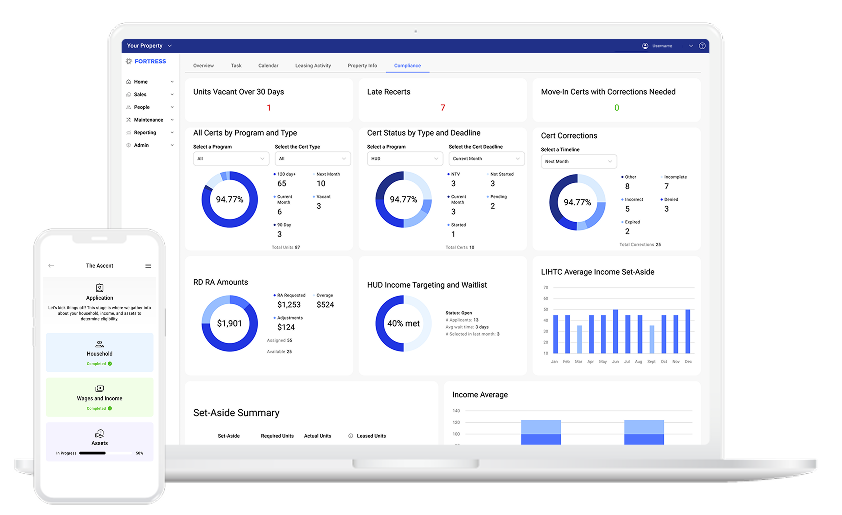
Fortress OS helps property teams centralize operational workflows across leasing, maintenance, compliance, reporting, and resident operations.
How does reporting help multifamily companies scale?
Reporting helps operators understand what is happening across their portfolio.
As companies grow, leaders need more than individual property updates. They need accurate information across communities.
Useful reporting helps teams understand:
|
Reporting area |
Why it matters |
|
Maintenance activity |
Helps identify delays and recurring issues |
|
Property performance |
Provides visibility across communities |
|
Compliance information |
Helps teams manage requirements consistently |
|
Operational trends |
Supports better decisions |
The best reporting tools reduce the need for manual exports and spreadsheet consolidation.
Real-time reporting should be real-time.
If a report requires three exports and the one employee who knows which spreadsheet formula is correct, that is not real-time data.
How does scalability impact multifamily software decisions?
Scalability is about more than supporting more units.
A system should support more users, more properties, more workflows, and more operational complexity without forcing teams to rebuild their processes.
Before choosing multifamily software, operators should ask:
- Can the platform support additional properties?
- Can workflows be standardized across communities?
- Can new team members learn the system quickly?
- Can the technology connect with other tools?
- Will reporting still work as operations grow?
The cheapest software is rarely the cheapest outcome.
The cost of fixing disconnected data, manual processes, and inconsistent workflows adds up over time.
Why do integrations matter for large multifamily operators?
Large operators rarely rely on one system for everything.
Accounting, payments, screening, communication, maintenance, and operational platforms often serve different purposes.
The strongest technology environments allow those systems to work together.
A connected technology stack helps teams avoid duplicate entry and gives leaders a clearer view of operations.
Fortress OS takes an integration-first approach, helping property teams connect the systems they already use.
A modern technology stack does not need to be one giant system.
It needs to be a group of systems that actually communicate.
What role does multifamily asset management software play?
Multifamily asset management software helps ownership and leadership teams evaluate portfolio performance and make strategic decisions.
While property teams focus on daily execution, asset managers need visibility into:
- Property performance
- Financial trends
- Operational results
- Portfolio opportunities
- Long-term strategy
The strongest organizations connect operational data with asset-level decisions.
Maintenance trends, occupancy information, and operational performance all provide valuable insight into how properties are performing.
Better decisions start with better information.
What can growing operators learn from the biggest multifamily companies?
Growing operators do not need to become massive overnight to benefit from mature processes.
The biggest lesson from large multifamily companies is that growth requires structure.
Successful operators build:
|
Growth challenge |
Mature operational approach |
|
Different processes at each property |
Standardized workflows |
|
Information spread across systems |
Centralized data |
|
Manual reporting |
Better visibility |
|
Employee-dependent knowledge |
Repeatable processes |
The goal is not adding more technology.
The goal is creating operations that can support growth without adding unnecessary complexity.
How Fortress OS supports multifamily operators as they grow
Fortress OS helps multifamily teams build stronger operational foundations through connected workflows and centralized information.
The platform supports key areas of property operations, including:
- Leasing
- Maintenance
- Inspections
- Compliance
- Reporting
- Resident workflows
Instead of managing disconnected processes, teams can work from a shared system of record and create more consistent operations across their portfolio.
For growing multifamily operators, the goal is not simply managing more units.
It's building systems that allow teams to operate well as those units increase.
Frequently Asked Questions
What software do large multifamily companies use?
Large multifamily companies typically use a combination of property management software, accounting systems, maintenance tools, resident communication platforms, and reporting solutions. The most effective technology environments allow these systems to share information.
How do multifamily companies scale operations?
Multifamily companies scale by creating standardized workflows, improving reporting, centralizing information, and using technology that supports consistent processes across properties.
What is multifamily management software?
Multifamily management software helps property teams manage daily operations such as leasing, maintenance, resident communication, reporting, and compliance workflows.
What features should multifamily operators look for in software?
Operators should look for workflow support, reporting capabilities, integrations, user management, maintenance tools, and the ability to support portfolio growth.
What is multifamily asset management software?
Multifamily asset management software helps ownership and investment teams analyze portfolio performance, financial trends, and long-term asset decisions.
Growth requires more than adding properties
The biggest multifamily property management companies are not successful because they have more buildings.
They are successful because they built the systems to support them.
The right technology helps teams spend less time managing processes and more time managing properties.
See how Fortress OS helps multifamily operators build operations ready for growth. Book a demo today.