
 Sign in to Fortress OS
Integrate With Fortress OS
Don't sacrifice the tools you love. Connect them into one aligned system.
Integration first. Designed to fit.
Built to work alongside your stack, not replace it.
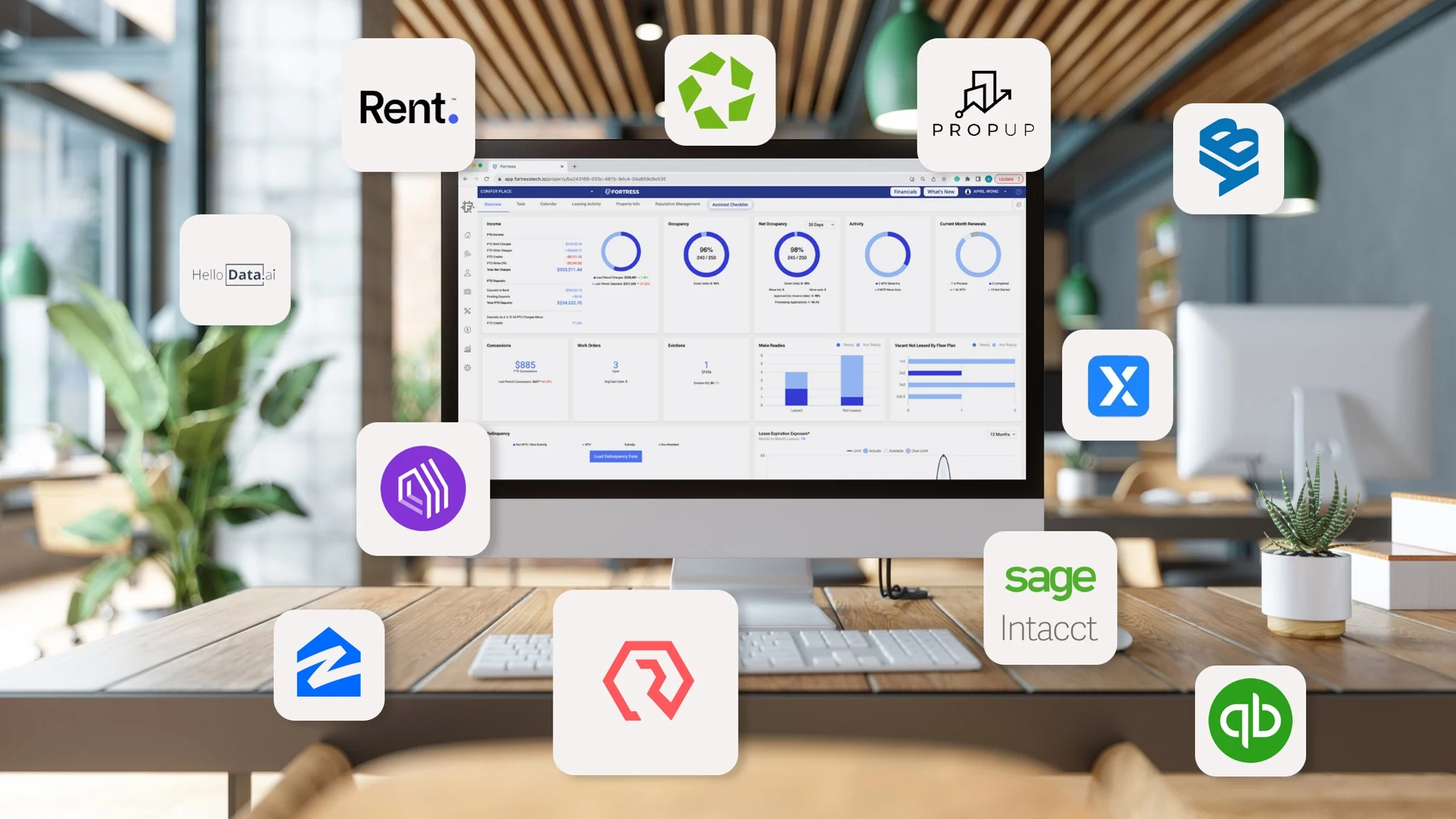
Integration Marketplace
Showing 1–10 of 43 integrations
Why Should You Integrate With Fortress OS?
Access a Growing Market
Connect with operators in the affordable housing space.
Support Real Operational Workflows
Integrate into systems used daily for compliance, leasing, and reporting.
Flexible Integration Approach
Built to support a wide range of platforms across the property management stack.
Shared Value for Customers
Help clients reduce manual work and improve data accuracy across systems.
How It Works

 Fortress OS
 Zillow
 QuickBooks
 AllTracs
 Apartments.com
 Domuso
 Conservice
System of coordination, not replacement
Unlike Yardi, we don't try to be everything for everyone.
- Plug into your existing tools — accounting, compliance, payments, and more
- Standardize how data flows between them
- Give your team one place to operate
Real-time data sync
- Updates in one system reflect everywhere else
- No manual re-entry
- No lag between teams
API Friendly→API First
- Direct API connections
- Pre-built integrations with common vendors
- Custom integrations when needed
Workflow-driven, not just data syncing
- Trigger tasks across systems
- Ensure processing stays consistent
- Remove the need to track where work lives
Centralized visibility
- Data is unified inside Fortress
- Teams see one source of truth
- Reporting becomes reliable
Instead of forcing teams to switch tools, it sits in the middle and keeps everything in sync.
For Operators. By Operators.
Fortress connects your tools and workflows behind the scenes, so your team isn't stuck double-checking, re-entering, or guessing where things stand.
Integration FAQs
Answers from our product team on partnering with Fortress OS — from process and timelines to data, security, and what we look for in a great integration.
Contact UsWhat integrations are available?
Fortress OS supports a variety of integrations, including technology integrations (e.g., Sendgrid, Twilio, Firebase) and point solution integrations for payments, work orders, collections, and more.
How does data flow between systems?
Data exchange can occur through APIs, SFTP, or custom integrations. APIs provide real-time data exchange, while SFTP is used for large, raw data exports. Custom integrations are less common and assessed on a case-by-case basis.
How often do integrations sync?
Sync timing depends on the integration type. For example, APIs can provide real-time updates, while SFTP setups may involve daily or periodic data loads.
What are the security measures for integrations?
Fortress ensures security through measures like SOC 1 and SOC 2 compliance, Okta SSO support, and secure API key provisioning. For point solutions, customers may need to manage separate login credentials unless single sign-on (SSO) is supported.
What is the process for enabling an integration?
The process typically involves: (1) documentation exchange, (2) API key provisioning, (3) SOC report exchange, (4) development and testing phases, and (5) end-to-end demo and acceptance.
Can integrations be customized?
While APIs and SFTP are the preferred methods, custom integrations can be considered as feature requests. These are evaluated and prioritized within 60 days.
What happens during onboarding for integrations?
Onboarding steps depend on whether the integration considers the property management company (PMC) or individual properties as the customer. Ideally, new properties are automatically discovered through the integration, but some solutions may require manual contract signing.
What are the potential integration points?
Common integration points include data exchange, onboarding, and authentication. These ensure seamless communication and functionality between Fortress OS and external systems.