Low cost property management software may save upfront money, but hidden costs like manual work, inefficiencies, and gaps often outweigh savings.
For many property owners and operators, cost is one of the first considerations when evaluating new software. It’s understandable. Budgets are tight, teams are being asked to do more with fewer resources, and every technology investment needs to demonstrate value.
That often leads organizations to search for low cost property management software, hoping to find a platform that meets their operational needs without stretching the budget.
The challenge is that software pricing only tells part of the story.
A lower monthly subscription may look attractive during the buying process, but the true cost of a property management system shows up in how efficiently your team can actually work. If staff are spending hours entering duplicate data, correcting errors, switching between disconnected systems, or managing manual workflows, those operational costs can quickly outweigh any upfront savings.
Choosing the right platform isn’t about finding the lowest price. It’s about understanding what that price actually means once the software is in daily use.
Looking Beyond the Monthly Subscription
When comparing vendors, it’s easy to focus on the monthly or annual subscription. That number is simple, visible, and easy to benchmark across platforms.
However, property management software price should never be evaluated in isolation.
Two systems can look very different on paper, but if one reduces manual work, improves reporting, streamlines compliance tasks, and helps teams operate more efficiently, the long-term return on investment can be significantly higher.
In many cases, the lowest-priced option doesn’t reduce cost. It shifts it elsewhere, usually into staff time, additional tools, or operational inefficiencies that become part of everyday work.
Instead of asking how much software costs, the better question is how much work it removes.
The hidden costs that don’t appear on the invoice
Some platforms keep subscription pricing low by limiting built-in functionality. At first, that can feel like a smart tradeoff. The price looks good, the interface is simple, and it seems like enough to get started.
The challenge is what happens after implementation.
When systems don’t connect workflows, teams become the bridge between tools. Data gets entered multiple times. Reports require manual reconciliation. Spreadsheets get created just to track what the system can’t handle. Over time, those small inefficiencies become part of daily operations.
Common hidden costs include:
- Duplicate data entry across systems
- Manual reporting and spreadsheet tracking
- Additional software subscriptions to fill gaps
- Increased compliance corrections
- More time spent fixing avoidable errors
- Slower workflows caused by disconnected processes
None of these show up on a pricing sheet, but they all impact how much work your team has to carry.
Easy to use shouldn’t mean limited functionality
Many teams search for easy property management software, assuming simplicity and capability can’t exist in the same system.
The reality is that the best platforms make complex work easier, not smaller.
Ease of use shouldn’t come from removing functionality. It should come from better design, clearer workflows, and systems that guide users through work instead of forcing them to manage it manually.
A well-designed system reduces training time, minimizes confusion, and helps teams move through tasks without needing workarounds or external tools.
True simplicity is about removing friction, not capability.
Where growth exposes software limitations
Software decisions made for today often get tested by tomorrow’s growth.
As portfolios expand, teams grow, and reporting requirements increase, systems that once felt manageable can start to show strain. Manual processes become harder to maintain, and disconnected workflows begin to slow operations.
Growth tends to expose one of two realities. Either the software scales with the organization, or the organization starts building around the software’s limitations.
The difference shows up in efficiency, consistency, and how much time teams spend managing systems instead of managing properties.
Why value always outlasts price
Every organization has budget constraints, and choosing software is never just a financial decision. But focusing only on price can create a narrow view of value.
A lower subscription cost may look attractive initially, but if it leads to more manual work, additional systems, or increased operational friction, the total investment becomes much higher over time.
The most effective software reduces effort, improves accuracy, and helps teams operate with more consistency. When that happens, the value extends far beyond the monthly subscription.
How Fortress OS delivers long-term value
At Fortress OS, we believe property management software should reduce work, not create more of it.
As the only property management software built affordable-first, Fortress OS was designed to support the complexity of affordable housing while also serving market-rate and mixed portfolios. Whether you’re managing LIHTC, HUD, RD, HOME, conventional communities, or a blend of property types, your team shouldn’t have to rely on disconnected systems or manual processes to keep operations moving.
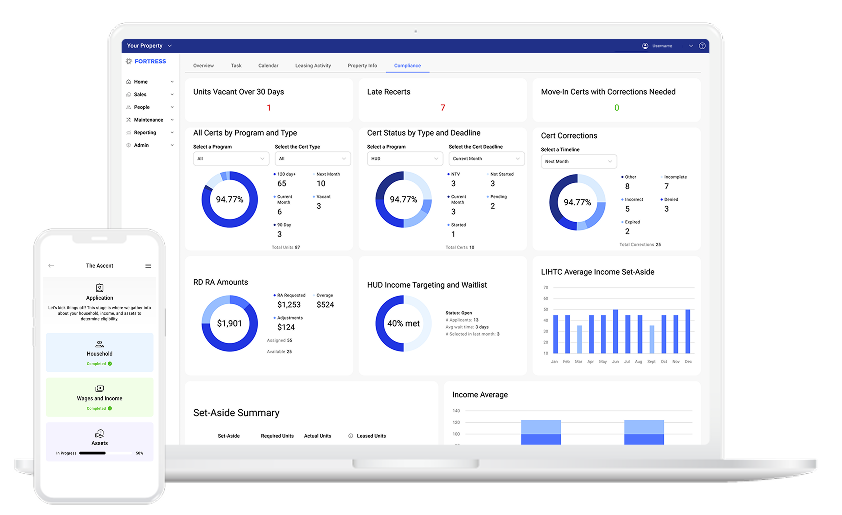
Fortress simplifies compliance, leasing, maintenance, income, and reporting in one intuitive, powerful system. By centralizing workflows and giving teams real-time visibility into their operations, Fortress helps reduce administrative work, improve accuracy, and scale efficiency across portfolios of any size.
Looking beyond the price
When evaluating property management software price, it’s worth looking beyond the subscription cost and considering the time saved, errors prevented, and operational efficiency gained over the life of the software.
Finding low cost property management software isn’t just about choosing the lowest monthly subscription. It’s about understanding the total operational impact the system will have on your team.
The right platform should reduce manual work, improve accuracy, support growth, and create long-term efficiency gains that compound over time.
Schedule a demo to see how Fortress OS helps property management teams reduce manual work, streamline operations, and support affordable housing, market-rate, and mixed portfolios from a single platform.