Not all property management software is built the same. Compare top options by use case to find the right fit for your team and operations.
Property management software companies are often evaluated as if one platform should fit every operation. In reality, the best software depends heavily on what you’re trying to manage, how complex your portfolio is, and where your operational friction actually exists.
Some teams need simplicity above all else. Others need compliance depth, reporting visibility, or the ability to manage multiple property types in one system. That’s where most comparisons fall short. A list of logos doesn’t explain what actually works in practice.
This guide breaks down how different property management software companies tend to perform based on real operational use cases, not just feature checklists.
The challenge with most property management software lists
If you search for a list of property management software or a property management software list, you’ll usually find the same companies repeated across every article.
Most of those comparisons focus on popularity, not operational fit. That’s where things get misleading.
The most popular property management software isn’t always the best choice for every team. What works for a small residential portfolio may struggle under compliance-heavy workflows or mixed property operations.
That’s why it’s more useful to compare use cases instead of rankings.
Use case 1: Simple residential leasing and rent collection
For smaller portfolios or teams focused primarily on leasing, rent collection, and basic maintenance tracking, ease of use tends to matter more than depth of functionality.
In this category, many real estate software companies prioritize simplicity, onboarding speed, and lightweight workflows. These tools are often designed to get teams up and running quickly without extensive configuration.
However, simplicity can come with tradeoffs. As portfolios grow, teams may find themselves relying on spreadsheets or external tools to fill operational gaps.
Use case 2: Mid-sized portfolios needing operational visibility
For growing operators, the focus shifts from basic functionality to visibility and coordination across teams.
This is where property management software companies begin to differentiate more clearly. The key requirement is no longer just tracking leases or rent, but understanding what is happening across properties in real time.
At this stage, reporting, maintenance workflows, and task management become more important. Many teams start evaluating whether their system can scale with them or whether it will require replacement within a few years.
This is often where the gap between “popular” and “operationally effective” software becomes clear.
Use case 3: Complex compliance-driven operations
For affordable housing, mixed-income portfolios, and regulated environments, software needs extend far beyond basic property management.
The most effective platforms in this category are not just tools for tracking data. They function as operational systems that support compliance workflows, documentation, recertifications, and reporting requirements.
This is where many traditional top real estate software companies fall short. They may offer strong leasing or accounting features, but struggle to support the complexity of layered compliance rules and audit-driven processes.
In these environments, workflow design matters more than individual features.
Use case 4: Mixed portfolios and multi-asset operators
Some organizations manage a combination of affordable housing, market-rate housing, and other property types. These operators often need flexibility without fragmentation.
The challenge here is avoiding a stack of disconnected systems. Many teams end up using one platform for leasing, another for compliance, and additional tools for reporting or communication.
That fragmentation creates inefficiency over time.
The most effective top rated property management software for this use case tends to focus on unifying workflows rather than specializing in a single function.
What actually separates property management software companies
Across all categories, the differences between property management software companies usually come down to a few operational factors:
- How well workflows are connected across teams
- Whether data has to be entered multiple times
- How reporting is generated and maintained
- How easily the system adapts as portfolios grow
- Whether users need external tools to complete core work
These factors matter more than whether a platform appears on a most popular property management software list.
Popularity reflects adoption. It doesn’t always reflect operational fit.
How to evaluate the right software for your use case
Instead of starting with a top real estate software companies list, it’s more effective to start with your internal workflows.
Ask:
- Where does manual work still exist?
- What processes break as we scale?
- Where do systems require duplication?
- What takes the most time outside of resident service?
Once those answers are clear, it becomes easier to evaluate which platforms actually solve those problems instead of adding new layers of complexity.
Fortress OS perspective
At Fortress OS, we believe property management software should reduce operational friction, not add to it.
As the only property management software built affordable-first, Fortress OS supports both affordable housing and market-rate portfolios, including mixed and complex operations that require more than basic leasing tools.
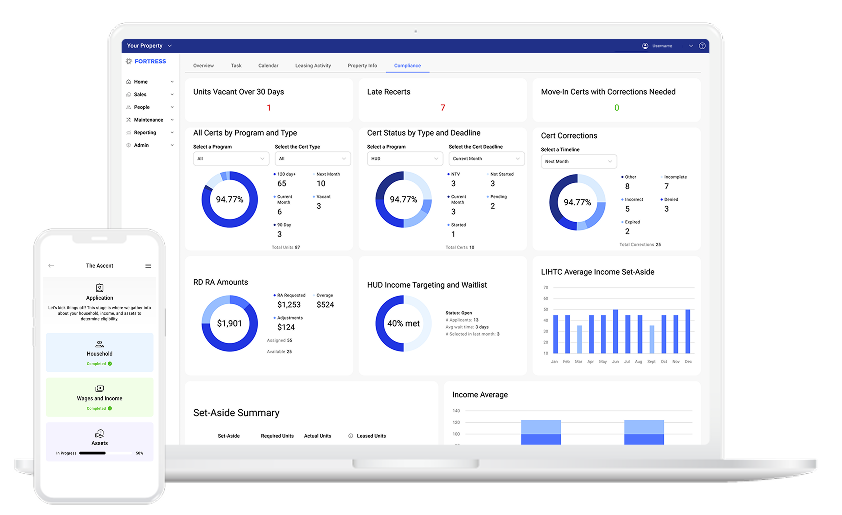
Fortress simplifies compliance, leasing, maintenance, income tracking, and reporting in one connected system. Instead of forcing teams to rely on disconnected tools or manual workarounds, it centralizes operations into a single workflow-driven platform.
When evaluating property management software companies, the real question isn’t which platform is most popular. It’s which platform actually helps your team operate more efficiently every day.
Schedule a demo to see how Fortress OS helps property management teams reduce manual work and streamline operations.